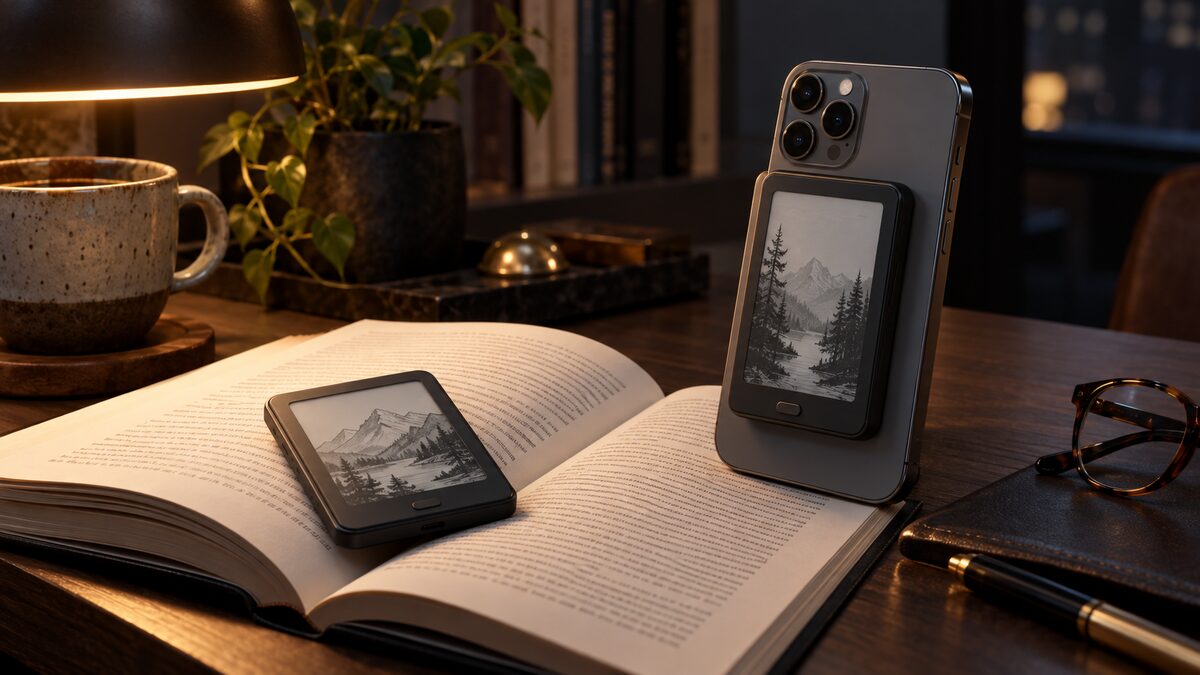
The best tech trend of 2026 fits in your wallet: e-readers got tiny, and suddenly everyone is reading in line for coffee instead of scrolling.
Why small won
The insight behind this wave is simple: the book you finish is the book you have with you. Pocket e-readers attach to your phone, slip into a jacket, and turn dead time into chapters. Reviewers who carried them report something close to a habit transplant: waiting rooms, train platforms, and checkout lines become reading time, and screen time reports start looking very different.
The pitch across all three devices is the same: make reading the path of least resistance. A reader in your pocket turns dead time into chapters, and chapters compound. Owners routinely report finishing a book a week without changing anything else about their lives, which is the kind of claim that sounds like marketing until it happens to you.
The three to know
Xteink X3 ($55) is the budget darling: credit-card tiny, magnetizes to the back of your phone, and priced like an impulse buy. The trade-off is real, though. It takes tinkering to set up and does not talk to Kindle, Libby, or other book ecosystems. Buy it for the tinkerer in your life.
The X3 is the purist’s pick: E Ink, your own EPUBs, and nothing else. No store nagging you, no notifications, no color. The battery is measured in weeks, and the whole thing costs less than a hardcover box set. The trade is homework: sideloading files and basic typography. It is a reader’s reader, happily stuck in the best way.
Xteink X4 Pro ($99) adds the feature that changes everything: a backlight. Reading in bed without waking a partner makes it the pick for most people, and it is slightly larger and more comfortable for long sessions.
The X4 Pro splits the difference, keeping the open, bring-your-own-books philosophy while smoothing the rough edges: better screen, better buttons, better battery. For most people it is the answer.
The Palma Pro 2 plays a different game entirely. Android with full app access on an E Ink screen reframes what a small reader is: Pocket, Libby, your library’s app, even light messaging all run, all easier on the eyes than a phone. Battery lands at days rather than weeks, the price of real computing.
None of the three has a color screen, and page turns on E Ink still blink rather than glide. If your reading is graphic novels and glossy magazines, stay on a tablet. For words, though, E Ink remains undefeated: readable in sun, gentle at midnight, and impossible to doomscroll.
Worth repeating for the skeptics: these are not phones and do not want to be. The whole point is subtraction. Every device in this roundup exists because someone looked at their screen-time report and decided the fix was hardware, not willpower. The sales charts suggest they were right.
Boox Palma Pro 2 ($400) is the no-compromise option: a phone-sized e-ink device that runs real reading apps, so your Libby loans, Kindle library, and Kobo books all come along. It is the pocket e-reader for people who already own ebooks and refuse to rebuy them.
- Xteink X3: cheapest way in, best for the DIY-minded
- Xteink X4 Pro: the backlight makes it the crowd favorite
- Boox Palma Pro 2: premium, app-friendly, library-loyal
Which one is yours?
Casual readers and gifters should start with the X4 Pro. Heavy library users should save up for the Palma Pro 2. And if you just want to test whether pocket reading sticks, the X3’s $55 ticket is hard to argue with.
Which pocket reader is yours
Choose the X3 at $55 if you want the cheapest door into phone-free reading and you already own your books. Choose the X4 Pro for the same soul with fewer compromises, or the Palma Pro 2 if you want one device to absorb your reading apps and tame your phone habit.
Either way, the real product is identical: an evening with a book instead of a feed.
Pros
- Makes reading as convenient as scrolling
- Options at $55, $99, and $400
- Genuinely changes daily reading habits
Cons
- Xteink models need setup patience and skip major book apps
- E-ink still means no color covers and slower page turns